
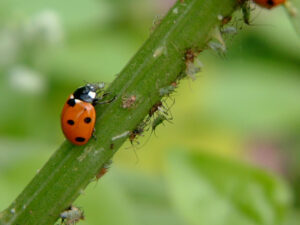
2025 was the ‘Year of the Aphid’: is it time to rethink the traditional British veg patch?
2025 has been dubbed the ‘Year of the Aphid’ as new data from Garden Organic and the grow-your-own app Fryd reveals that climate extremes are making it harder for UK gardeners to grow the traditional vegetables their grandparents relied on.
Findings from the sustainable gardening charity’s recent annual citizen science survey, run with popular veg growing app Fryd, show while 2024 was dubbed the ‘Year of the Slug’, 2025 seems to have been the ‘Year of the Aphid’. Hot, dry conditions fuelled a surge in pest outbreaks, crop bolting and poor harvests for some of our most familiar home-grown favourites. However, sun-loving veggies such as tomatoes and amaranth flourished.
According to the Met Office, 2025 was the UK’s warmest and sunniest year on record, with the second driest spring ever recorded. While slugs were largely absent, dry soils and high temperatures created ideal conditions for black bean aphids on broad beans and cabbage aphids on brassicas, and caused early bolting in crops like lettuce.
Dr Anton Rosenfeld, who leads Garden Organic’s citizen science programme, said: “Some of our traditional British crops are struggling to cope with theextremes of seasons: an onslaught of slugs in wet years, and a plague of aphids or early bolting in dry years. Milder winters often mean that more slugs survive into the following year. Runner beans have faired consistently badly in hot seasons, with pods frequently failing to set.
“We will have to diversify our range of crops to cope, including more drought resistant leafy crops such as amaranth, and growing more perennial crops that have better ability to cope with drought and the challenges posed by pests.”
He added: “As 2024 was year of the slug, 2025 was year of the aphid, with brassica crops being plastered in cabbage aphids in the early part of the season. As is common, aphids departed in early July and many crops recovered surprisingly well when the rains arrived.”
Garden Organic’s best and worst performing crops of 2025
The survey shows a clear split between crops that struggled under drought stress and those that thrived with warmth and careful management:
- Runner beans performed worst overall for the second time in recent dry years, with nearly half producing poor or no yields due to lack of water and poor pod set.
- Lettuces bolted rapidly in summer heat, forcing gardeners to reply on rapid succession sowing.
- Squashes avoided the slug damage seen in 2024 but performed unevenly. Well-established plants with reliable water did well but 40% produced poor or no yields with early powdery mildew, poor fruit set and stalled growth common in dry conditions.
- Brassicas struggled early due to aphids, cabbage white butterflies and bolting but crops that survived recovered later in the season to deliver good autumn harvests.
- Onions delivered mixed results. Growers using mulch or no-dig beds achieved good yields but many saw poor growth or undersized bulbs, often thanks to dry, compacted soil and limited watering.
- Carrots also had a mixed year. Germination often failed in hot, dry soil but crops that established well, produced good harvests once rain returned, helped by low slug damage and a dearth of carrot fly.
- Potatoes struggled in hot, dry soil with many gardeners reporting undersized spuds and scab, despite lower levels of blight and slug damage.
- Tomatoes were the strongest performer, benefitting from the warmth and easier irrigation in pots and greenhouses.
- Chard and amaranth showed resilience, with amaranth described by one grower as a ‘star crop’ during the heat. Amaranth is mostly grown in the UK for its tasty leaves which are a bit like spinach.
Some of the growers stressed even if they achieved good results, this was thanks to an array of adaptation measures such as mulching, good soil preparation through no-dig, using shade cloth and successional sowing.
For 65 years, Garden Organic has brought gardeners together to share what works on their organic plots via its citizen science projects. The 2025 survey marked a step change in how Garden Organic collects data. By teaming up with Fryd, gardeners can now record crop performance directly on their phones as they grow, turning everyday observations into useful citizen science insights.
Florian Hassler, co-founder of Fryd said: “What gardeners experienced in 2025 is exactly why we need better, real-world data. Yet much of the advice gardeners are given hasn’t changed for decades.
“With Fryd, gardeners can record what’s actually happening in their own plots, in real time. When thousands of people do that together, we can start to build growing advice that reflects today’s climate not the one our grandparents gardened in.”
ENDS
- In its annual survey Garden Organic asks gardeners to rate the performance of ten common crops on a scale from 1-5. The aim is to gather information that can be used to provide a helpful summary of how each crop responded to the climatic conditions around the UK.
- The survey, now in its fourth year, gathered responses from over 300 gardeners with the help of digital gardening app Fryd.
Press Contact: Emma Mason, emma@emmamasonpr.co.uk 07762 117433
Florian Haßler Co-Founder Fryd GmbH +49 174 33 29 352, florian@Fryd.app
Alice Whitehead, Garden Organic, 01604 700 652, awhitehead@gardenorganic.org.uk.
About Fryd
Fryd (pronounced Frood) is one of Europe’s most popular garden planning apps, helping over 300,000 gardeners plan, grow and share their veg patches. Thedigital garden companion allows users to create bespoke planting plans for their gardens or allotments, discover companion planting combinations, and get personalised sowing advice based on local climate and frost dates.
Fryd is steward-owned, purpose-driven and promotes eco-friendly, sustainable gardening.
Fryd Lab, available in the free version of the app, offers access to community-led citizen science experiments. Fryd is available to download in the UK on both iOS and Android platforms. Joining the Fryd community is free or subscribe to Super Fryd (£9.99 p/month, £44.99 p/year or £179.99 lifetime subscription) which boasts lots of enhanced features.
About Garden Organic
Garden Organic promotes organic growing and composting, citizen science and research, and seed conservation through its Heritage Seed Library. Its aim is to help people grow ‘the organic way’, using natural methods to promote healthy, biodiverse, sustainable gardens.
Founded in the 1950s as the Henry Doubleday Research Association, it has been leading the way in researching and demonstrating best practice organic growing for more than 65 years and brings together a movement of thousands of growers keen to have a positive impact on the green space they nurture.
For more information visit www.gardenorganic.org.uk, or follow @gardenorganicuk on Twitter/X, Facebook, Instagram, and TikTok.